
The wrong choice shows up as surging flow, damaged product, starved packaging machines, slow changeovers, and weighing errors. Hopper design alone matters: an improperly designed hopper or transition can cut feeder capacity by as much as 30%, according to Eriez.
This article walks through the decision criteria: primary function, material characteristics, rate, distance, layout, discharge needs, and the process downstream.
Key Takeaways
- A conveyor transfers material between process points; a feeder meters it into the next machine.
- Flowability, bulk density, fragility, abrasiveness, temperature, and moisture shape the design.
- Start with a conveyor for point-to-point movement, a feeder for controlled discharge from a hopper.
- Combine them when a line needs both accurate metering and longer transport.
Vibratory Conveyor vs. Vibratory Feeder: Quick Comparison
Classification follows the job, not the hardware. A short conveyor and a long feeder can look identical, and some equipment performs both roles.
| Factor | Vibratory conveyor | Vibratory feeder |
|---|---|---|
| Primary function | Transfers material along a defined path | Regulates or meters material into downstream equipment |
| Typical position | Between process stages | Below a hopper, bin, silo, or supply point |
| Material control | Consistent movement and transfer | Controlled rate, dosing, or discharge |
| Key design concerns | Length, elevation, trough construction, sanitation, wear | Feed rate, discharge accuracy, hopper design, controls |
| Best outcome | Dependable movement between stations | No surges, starvation, or bridging at the next process |
Both can handle powders, granules, pellets, parts, food products, chips, and scrap when designed properly. Manufacturers such as Eriez and Cleveland Vibrator recommend or offer sample testing before purchase, so plan on it.
What Is a Vibratory Conveyor?
A vibratory conveyor is a trough, pan, tube, or platform that uses controlled vibration to move material along a line. In a common layout described by Carrier, a spring-supported pan sits above a base. The drive throws material up and forward in short hops, combining vertical lift with horizontal advance.
The trough must be isolated from the frame so the energy moves product, not the surrounding structure.
Drives and Design Variations
Drive choice matters. Key Technology contrasts two common options:
- Mechanical out-of-balance drives: higher amplitude and lower frequency, suited to heavier or rugged duty
- Electromagnetic drives: lower amplitude and higher frequency, with variable motion for precise metering
Confirm amplitude and frequency figures for any model you consider; manufacturer comparisons vary.
Common variations include:
- Stainless-steel troughs and sanitary or clean-in-place designs
- Wear or corrosion liners for abrasive material
- Dust-tight covers and enclosed troughs
- Inclined configurations, depending on the material
- Screening, dewatering, cooling, and jacketed heating or cooling
- Custom lanes and dividers
Operationally, conveyors give steady transfer, low-profile layouts, no belt return path, and straightforward cleaning.
Conveyor Use Cases
Conveyors typically carry product from a press, crusher, hopper, fryer, or freezer to inspection, weighing, filling, or packaging. Documented materials include:
- Hot forgings and delicate stamped parts (JOEST)
- Castings, sand, and metal scrap (Webster, Syntron)
- Metal or plastic parts (Webster)
- Food products in sanitary designs (Carrier)
- Steel abrasives reclaimed and returned to shot-blast systems (Syntron)
A conveyor can do more than transport. At Zarecki in Poland, Key Technology installed five Impulse shakers in 2022: three screened liquid-removal conveyors, a 90-degree transfer, and a laned spreader feeding the dryer.
The line handles up to 2 metric tons per hour of fragile berries and other fruit, and the customer reports easier operation and preserved quality.

What Is a Vibratory Feeder?
A vibratory feeder uses vibration to withdraw, regulate, or dose material from a hopper, bin, or bowl into a downstream scale, filler, press, conveyor, or process.
The flow-control role defines it, not size or construction. A short conveyor whose main job is controlled discharge works as a feeder.
How Feed Rate Is Adjusted
What you can adjust depends on the design:
- Electromagnetic pan feeders: amplitude through AC voltage. Frequency is design-specific, and Eriez warns that frequency shifts can cause spring stress and tray failure.
- Mechanical two-mass feeders: adjustable-angle rubber springs, variable-speed sheaves, or variable-frequency controls.
- Eccentric-weight feeders: weight adjustment, with limited rate adjustability.
- All types: hopper gate opening and trough geometry change bed depth and discharge volume.
Variants include tray or pan feeders, tube feeders, small-parts bowl feeders, and heavy-duty units for aggregates and scrap.
Limitations and Risks
- Sticky or cohesive material: high-deflection units handle some slightly sticky products, but fines can fluidize on high-frequency electromagnetic units.
- Bridging and rat-holing: hopper design has to prevent them.
- Degradation: high-deflection motion suits friable foods and glass fibers.
- Tuning and structure: striking can damage a feeder, and vibrating supports can reduce capacity.
Feeder Use Cases
Feeders carry material from storage to processing at a controlled rate. Documented applications include:
- IQF poultry weighing, where JBT Marel uses vibratory feeding
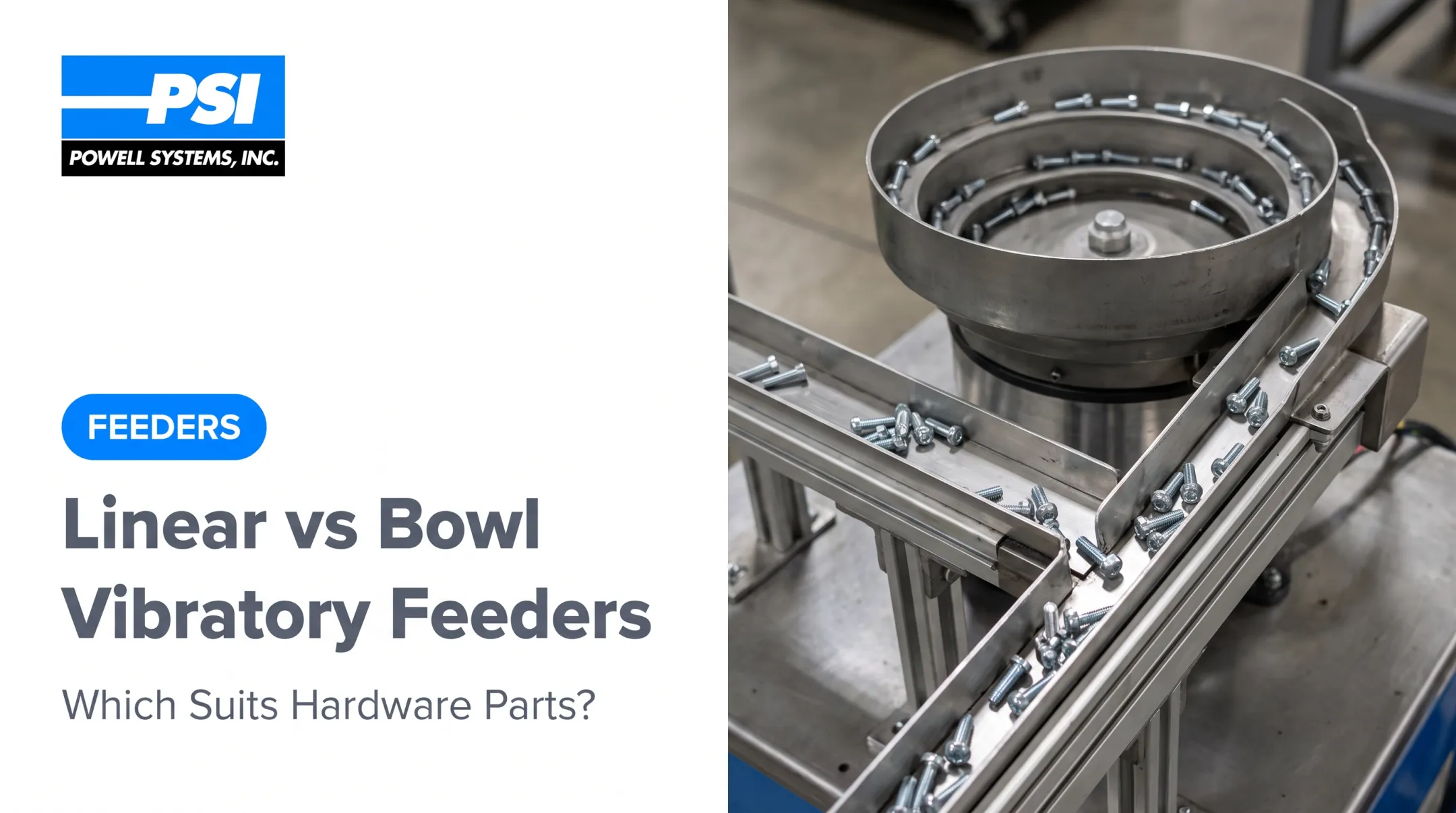
- Fastener orientation with bowl feeders (RNA Automation)
- Pharmaceuticals, chemicals, and plastics (Cleveland Vibrator)
- Foundry steel and sand, scrap, glass cullet, and crushed limestone (Cleveland Vibrator)
Choose a feeder over a conveyor when discharge is inconsistent, the next machine needs a set rate, or accuracy depends on weighing, dosing, or presentation. Key Technology notes that fast-start/stop electromagnetic shakers suit accurate scale feeding.
Counting is a system function. Hoosier's bowl orients clips, but a separate counting system does the counting and batching.
Powell Systems pairs vibratory feeders with weigh and count fillers the same way. Its AWC Series moves product over one or several vibratory feed pans into a weigh hopper. Load cells signal a microprocessor, feeding stops at the programmed weight, and the hopper dumps into a bag, box, or container.
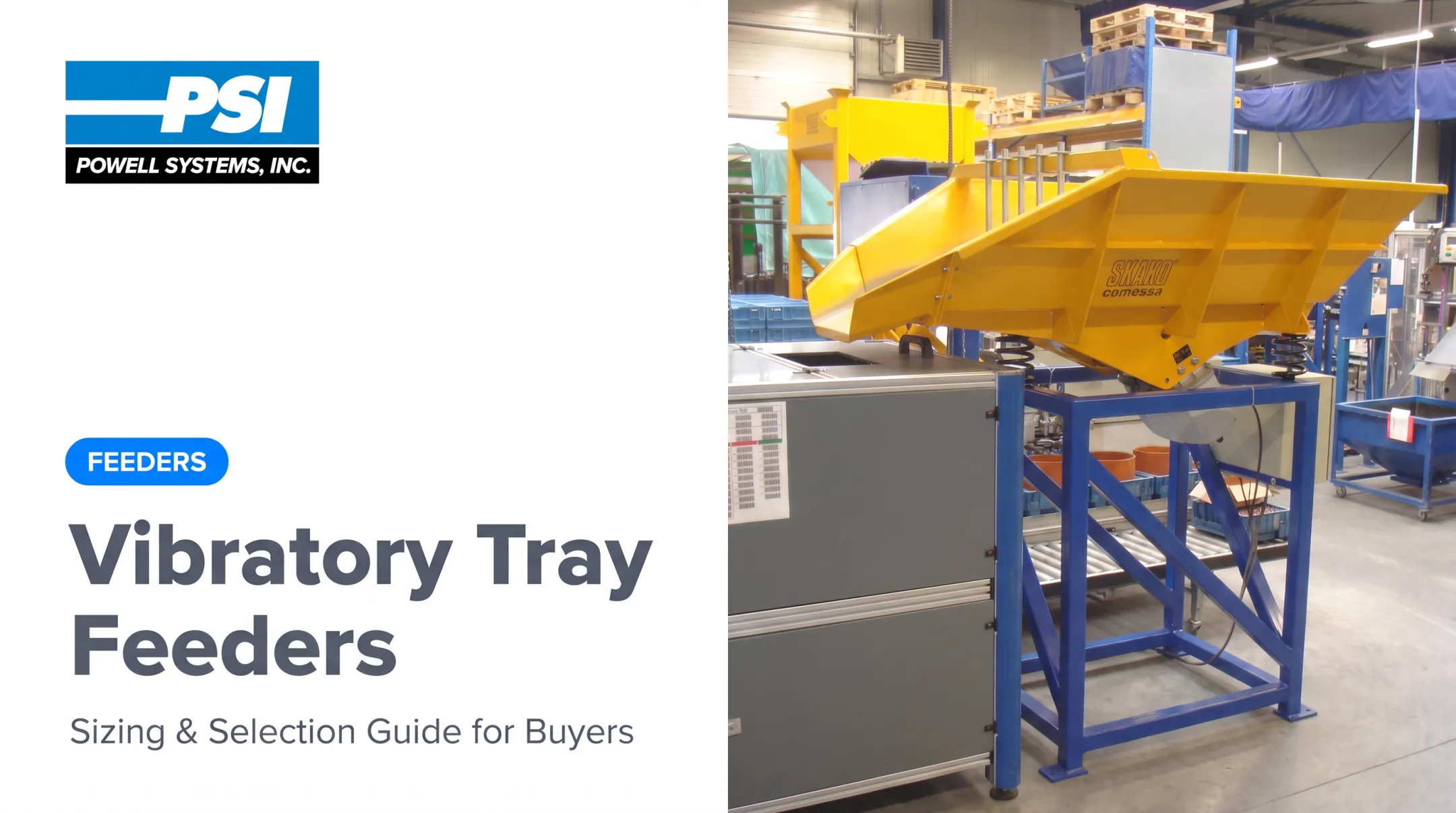
Giveaway can average less than 1/8 oz for smaller pieces. For interlocking, hard-to-feed hardware, Powell offers SKAKO vibration feeders with its weigh/count fillers.

Vibratory Conveyor vs. Vibratory Feeder: What Is Better?
Neither wins universally. The answer depends on whether your line needs transfer, metering, or both.
Choose a conveyor when you need:
- Point-to-point movement over a defined distance
- Spreading, screening, dewatering, or inspection
- Low-profile transfer or rugged handling
Choose a feeder when you need:
- Controlled withdrawal from a hopper or bin
- Consistent delivery to a scale or filler
- Synchronization with a downstream process
Choose both when a feeder regulates discharge from storage and a conveyor carries the material to weighing, packaging, or inspection. Eriez notes the two are often used together.
Selection Checklist
Gather these before talking to a supplier:
- Material type, particle size, bulk density, and flowability
- Moisture, temperature, abrasiveness, and fragility
- Feed rate and total capacity
- Conveying distance, elevation, and available footprint
- Sanitation, cleaning, and noise requirements
- Controls and start/stop duty
- Maintenance and expected future product changes
Real-World Examples
Covia, Chardon, Ohio: A Feeder Upgrade
Feeder failure could halt Covia's processing plant. The operation upgraded one Eriez 65B to a 65B-HC high-capacity electromagnetic feeder.
In performance testing, the new unit delivered roughly twice the throughput of the previous model. That result is specific to the test, not a plant-wide or universal gain.
Zarecki: A Conveyor System
Zarecki needed to handle fragile berries, multiple fruits, and fast changeovers during expansion. The five-shaker conveyor system buffers batch input so the dryer runs continuously. The line is rated at about 2 metric tons per hour; that figure is system capability, not a before-and-after gain.
Takeaway
Covia's problem was discharge capacity, so a feeder fit. Zarecki's was transfer, dewatering, and spreading, so conveyors fit. Many lines need both.

If your line also involves weighing, filling, or shipping, Powell Systems can review a custom material-handling and packaging system that coordinates feeding, weighing, and conveying around your product.
Conclusion
A vibratory conveyor is primarily a transfer solution. A vibratory feeder is primarily a metering and controlled-discharge solution. Match the machine to the job on your line.
The right pick delivers:
- Steadier flow
- Less downtime
- Less product damage
- Lower labor needs
- Reliable weighing and packaging
Test your material and have the supplier's engineers review the application before you buy.
Frequently Asked Questions
What is a vibrating conveyor?
It is a conveyor whose vibrating trough or pan advances material through repeated upward-and-forward movements. It handles bulk solids, parts, food products, and scrap.
What type of conveyor is used for moving loose bulk materials?
Vibratory conveyors are commonly used for controlled movement of loose bulk materials. The final choice depends on material properties, capacity, distance, elevation, sanitation, and downstream needs.
What is the difference between a vibratory conveyor and a vibratory feeder?
A conveyor transfers material between locations; a feeder regulates or meters material into the next machine. Similar hardware can sometimes do both.
Can a vibratory feeder also move material like a conveyor?
Over a short path, yes. But its defining purpose is controlled discharge or dosing, not extended point-to-point conveying.
How do I choose the right vibratory feeder or conveyor?
Start with material characteristics, feed rate, throughput, distance, and elevation. Then weigh product sensitivity, sanitation, space, controls, and upstream and downstream equipment.
Can a vibratory conveyor and feeder be used together?
Yes. A feeder meters material from a hopper or bin, and a conveyor carries it to weighing, processing, inspection, or packaging.