Introduction
The right steel container directly impacts your operation's efficiency, safety record, and profitability. The wrong container leads to damaged products, workflow bottlenecks, preventable worker injuries, and unnecessary replacement costs that drain your budget year after year.
The stakes are substantial. Workplace injuries from improper material handling cost U.S. businesses over $58 billion annually, with object handling alone accounting for $12.63 billion in claims.
The industrial sector is responding: the global material handling equipment market is projected to reach $248.6 billion by 2029, reflecting widespread investment in standardized solutions that improve logistics efficiency and cut long-term ownership costs.
This guide walks you through the technical specifications, compliance requirements, and strategic considerations that separate containers built for your specific operational needs from generic solutions that create more problems than they solve.
Key Takeaways
- Steel containers last 10-15 years versus 3-5 years for plastic or wood—dramatically lowering total ownership costs
- Six key factors drive selection: material gauge, design type, load capacity, fork entry configuration, dimensional specs, and compliance standards
- Custom designs pay for themselves in under one year through reduced damage, optimized space utilization, and labor savings
- Industry compliance isn't optional: OSHA 1910.176 governs stacking safety, AIAG standards control automotive dimensions, FDA 21 CFR 117.40 mandates food-grade materials
What Are Industrial Steel Containers?
Industrial steel containers are heavy-duty, reusable metal bins designed to safely transport, store, and organize materials throughout manufacturing and distribution facilities. These engineered solutions replace disposable packaging with durable systems that withstand decades of forklift handling, stacking stress, and demanding production environments.
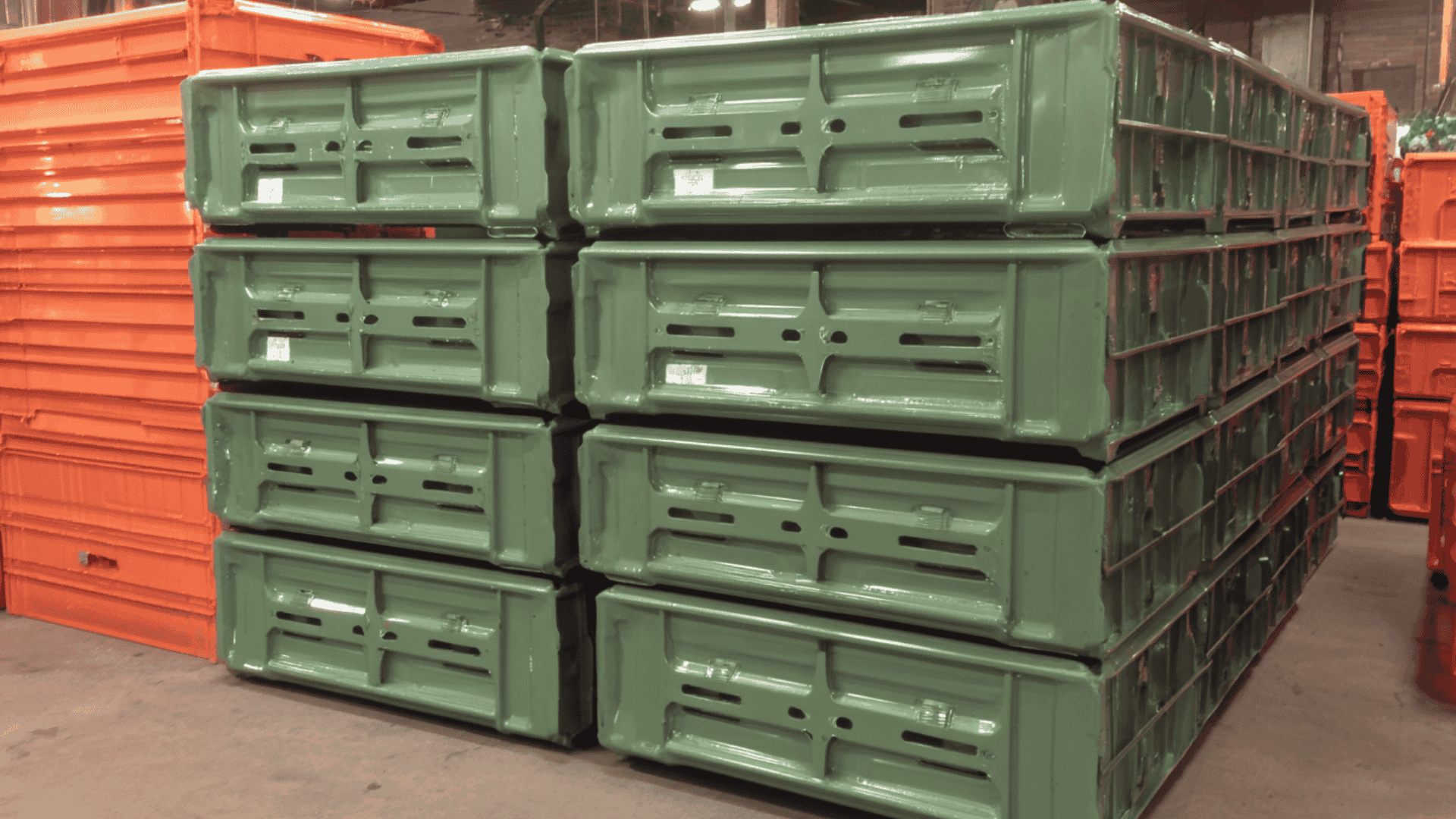
Primary types include corrugated steel containers with ribbed walls, wire mesh containers offering visibility and ventilation, and solid-wall steel bins for complete containment of small parts.
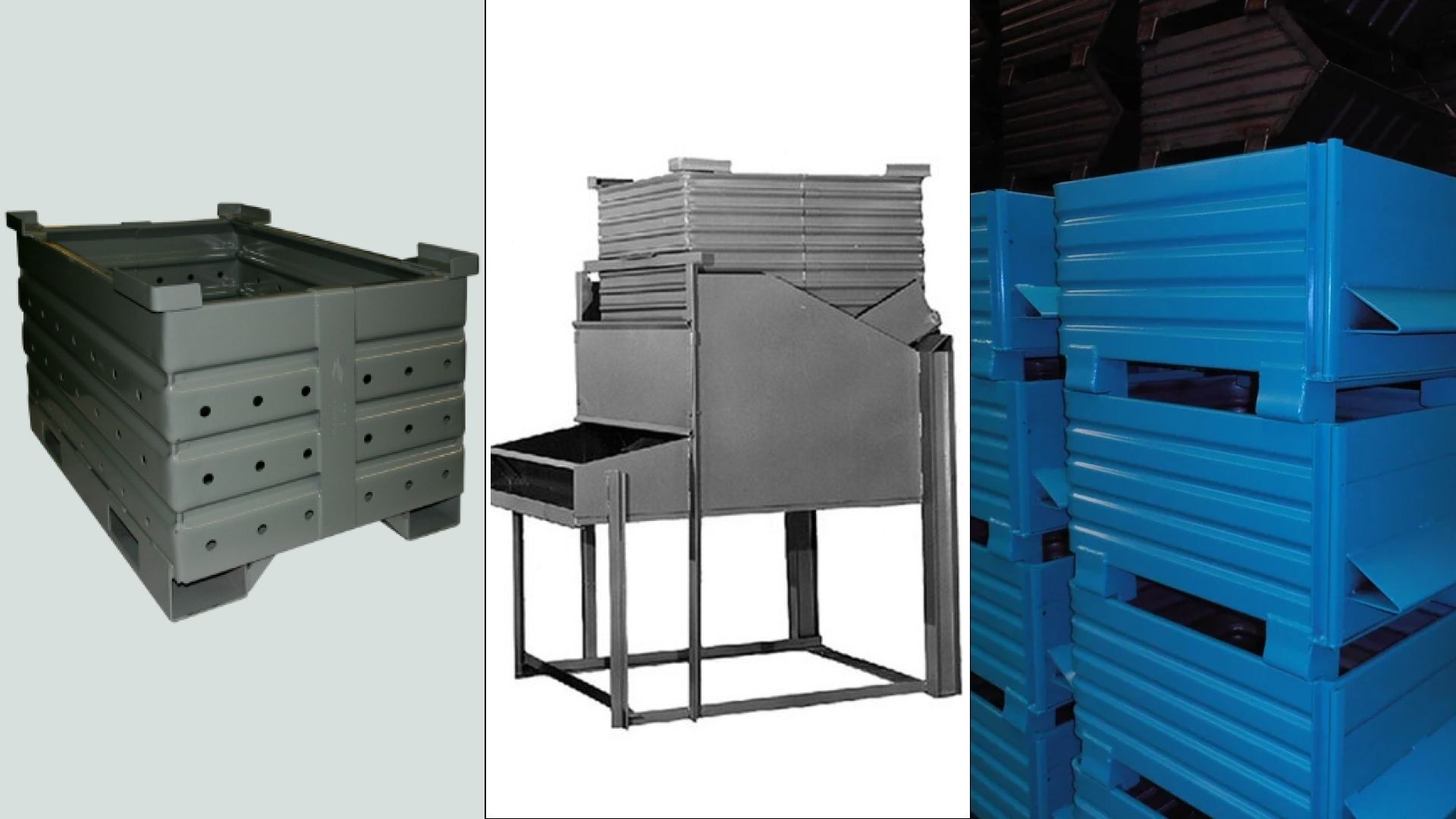
Specialty designs like gravity-feed containers improve picking efficiency, while drop-bottom units enable rapid emptying without tipping.
Core Components of Steel Containers
Understanding the functional anatomy of steel containers helps buyers identify which features align with their operational needs and avoid paying for unnecessary features that don't deliver value in their specific application.
Container Body and Wall Construction
Steel containers come in three main wall construction types:
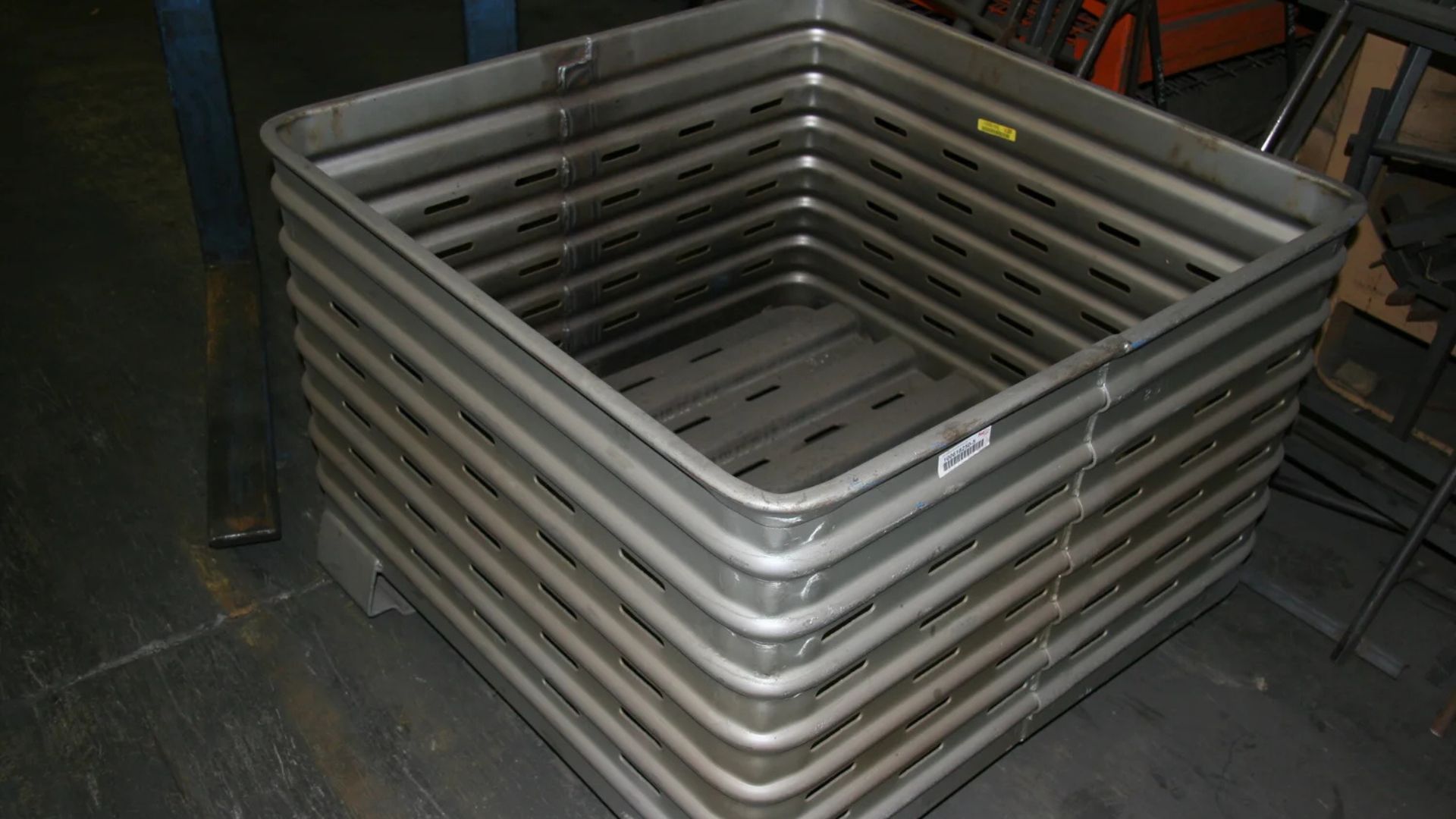
- Corrugated construction: Ribbed walls provide exceptional strength-to-weight ratios and partial visibility—ideal for heavy automotive and foundry parts
- Solid-wall designs: Complete containment for small fasteners and liquids, easier cleaning for food-grade operations, but weigh 15-20% more
- Wire mesh construction: Maximum visibility and ventilation for quick inspection and airflow-dependent applications
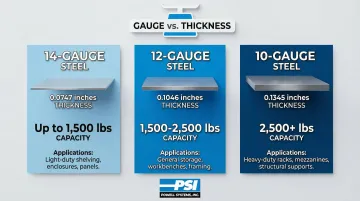
Gauge thickness determines load capacity and lifespan—14-gauge steel (0.0747 inches) suits medium-duty applications up to 1,500 lbs, while 12-gauge (0.1046 inches) handles 1,500-2,500 lbs, and 10-gauge (0.1345 inches) supports heavy industrial loads exceeding 2,500 lbs. The gauge system works inversely: lower numbers indicate thicker, stronger metal.
Base and Fork Entry Design
Base construction significantly impacts performance. Solid bases provide maximum strength and prevent small parts from falling through, slatted bases allow drainage of cutting fluids in machining operations, and mesh bases combine drainage with reduced weight. The base must distribute load evenly across forklift tines to prevent deflection under maximum capacity.
Fork entry configuration determines handling flexibility: 2-way entry (fork pockets on two opposite sides) costs less but limits approach angles, while 4-way entry allows forklift access from any direction, critical in congested warehouse aisles. Standard fork pocket dimensions are approximately 14 inches wide by 4.5 inches high with 69-inch spacing for large containers.
Stacking and Nesting Features
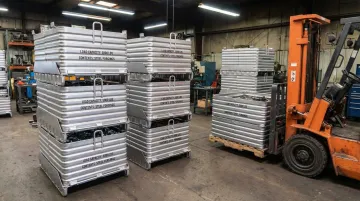
Formed offset stacking legs enable containers to stack securely when full while maintaining stability. Corner reinforcements prevent deformation under vertical loads—properly designed containers rated for 4,000 lbs can safely stack 4-5 high. Nesting capability allows empty containers to nest partially inside each other, reducing return shipping costs by 60-70% compared to non-nesting designs.
Handles, Gates, and Access Points
Drop-gates with safety latches allow controlled parts discharge without tipping the entire container. Hinged doors on container sides enable loading of large assemblies. Handle designs affect worker comfort—integrated handles positioned at proper heights reduce back strain when manually positioning containers. Wire or perforated gates provide visibility while containing parts during transport.
Benefits of Steel Containers in Industrial Settings
These structural components work together to deliver measurable operational advantages across manufacturing and distribution environments.
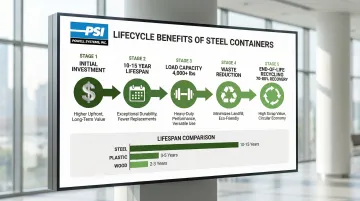
Steel containers deliver 10-15 year lifespans under normal industrial use, dramatically outperforming wood (1-2 years) and plastic (3-5 years) alternatives. This durability reduces replacement frequency and lowers total cost of ownership by 40-60% over a decade despite higher initial purchase prices.
Superior load capacity sets steel apart—heavy-duty corrugated containers safely handle up to 4,000+ lbs, with specialized designs supporting 6,000 lbs. This capacity enables shipment consolidation, reducing the number of trips required and improving logistics efficiency.
Enhanced worker safety comes from eliminating wood splinters that cause hand injuries and plastic cracking that creates sharp edges.
Steel's stable stacking reduces tip-over risks that cause the 20.1 injuries per 10,000 workers attributed to "struck by object" incidents annually.
Improved inventory visibility comes from wire mesh or low-wall designs allowing quick visual inspection without opening containers. This speeds cycle counts and reduces picking errors in high-volume operations.
Key operational benefits include:
- Waste reduction: Eliminates disposal fees for cardboard and wood packaging
- Sustainability support: Steel's recyclability recovers 70-80% of material value at end-of-life
- Fire resistance: Non-combustible classification protects facilities handling flammable materials, unlike plastic (melts) or wood (fuels fires)
What to Consider When Choosing the Best Steel Container
Steel container selection must balance technical specifications with real-world operational requirements—the right choice reduces labor hours, minimizes product damage, and improves throughput, while the wrong selection creates bottlenecks and hidden costs that compound over years. The following six factors connect container features to measurable business outcomes.
Material Type and Gauge Thickness
Gauge thickness is the single most critical specification for matching containers to load requirements. The gauge system measures metal thickness inversely—lower gauge numbers indicate thicker, stronger steel.
A 10-gauge container uses steel 0.1345 inches thick, while 14-gauge measures 0.0747 inches—nearly half the thickness.
12-14 gauge steel suits medium-duty applications like small stampings, fasteners, and packaged goods up to 2,500 lbs. 10-12 gauge handles heavy castings, forgings, and bulk materials exceeding 2,500 lbs. Going one gauge thicker adds 15-20% to container weight and cost but can double service life in demanding applications with frequent forklift impacts.
Steel alloy choice depends on environmental exposure:
- Carbon steel with industrial enamel paint for general manufacturing environments
- Hot-dip galvanized steel (ASTM A123/A153) for outdoor storage in construction and oil & gas
- 304 stainless steel for FDA-compliant food processing applications
- 316 stainless steel with molybdenum for acidic environments and chloride exposure
Powder coating and finish options prevent rust, improve cleanability, and enable color-coding for inventory management. Food-grade powder coatings create smooth, non-porous surfaces that meet FDA 21 CFR 117.40 requirements for cleanability and corrosion resistance.
Design Configuration Options
Once you've selected the right material, design features determine how well the container integrates into your workflow. Specialized configurations solve specific operational challenges.
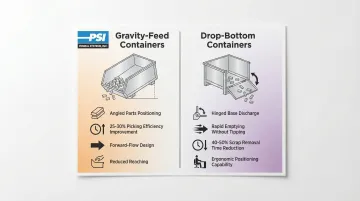
Gravity-feed containers position parts at an angle so components flow forward as removed, reducing reaching and improving picking efficiency by 25-30% in assembly operations. Parts remain accessible at the front edge without workers digging through containers.
Drop-bottom containers feature hinged bases that open to discharge contents rapidly without tipping. This design cuts scrap removal time in machining cells and enables precise parts placement at assembly workstations using custom stands that position the container at optimal ergonomic height.
Collapsible designs fold flat when empty, reducing return shipping costs by 65-75% for containers traveling between facilities. The trade-off is lower load capacity (typically 1,500-2,000 lbs maximum) and higher initial cost due to hinge mechanisms.
Wall height affects application suitability. Low-wall containers (12-18 inches) facilitate easy picking and visual inventory checks but provide minimal containment during transport.
High-wall designs (24-36 inches) secure parts during forklift movement and maximize cubic capacity but require workers to reach deeper, increasing ergonomic strain.
Wire mesh versus solid walls creates fundamental differences. Mesh construction allows visibility for quick inventory checks, provides ventilation for parts with cutting fluid residue, and weighs 20-30% less than equivalent solid walls.
However, mesh openings must be sized appropriately—2-inch mesh works for large castings but allows small fasteners to fall through, requiring 1/2-inch or smaller mesh or solid walls for small parts.
Customization options include interior dividers that segment containers for multiple part numbers, integrated bin boxes for small components, and label holders positioned for barcode scanning without opening containers.
Sizing for Load Capacity
Design features mean nothing if the container can't handle your loads safely. Calculate required load capacity by adding part weight, container weight (typically 150-300 lbs for industrial units), and dynamic loads during transport.
Forklift acceleration and braking create forces 1.5-2 times static weight—a container with 2,000 lbs of parts experiences 3,000-4,000 lbs of force during handling.
Build in a 20-30% safety margin beyond calculated loads. A container regularly loaded with 2,500 lbs should have a 3,000+ lb rated capacity to account for occasional overloading and maintain structural integrity over years of use.
Standard footprint dimensions align with racking systems and transport equipment. Common sizes include 32" x 40", 36" x 48", and 40" x 48" to match pallet dimensions. Automotive applications often use 48" x 45" per AIAG RC-12 standards. Custom dimensions optimize space utilization but may limit compatibility with standard racking.
The trade-off between maximizing load per container and maintaining safe handling weights requires analysis. Consolidating 3,000 lbs into one container versus 1,500 lbs in two containers reduces forklift trips but may exceed equipment capacity ratings or create ergonomic issues if any manual positioning is required.
Handling and Mobility Features
Fork pocket configuration determines equipment compatibility and handling efficiency. 4-way entry (fork pockets on all four sides) provides maximum flexibility in congested areas where approach angles are limited, but adds 10-15% to manufacturing cost. 2-way entry suits operations with straight-line material flow and controlled loading areas.
Fork pocket dimensions must match your forklift tine specifications. Standard industrial forklifts use 4-inch wide tines, requiring pockets at least 4.5 inches high with adequate reinforcement to prevent deformation.
Verify pocket spacing matches your equipment—standard 69-inch spacing doesn't work with narrow-aisle forklifts using 36-inch tine spreads.
Casters enable manual mobility for containers used in assembly areas where workers reposition units frequently. Specify 6-inch or larger swivel casters with locking mechanisms for loads exceeding 1,000 lbs. Fixed-base designs suit forklift-only handling and provide greater structural rigidity for stacking.
Tow-bar compatibility matters for facilities using train systems that move multiple containers simultaneously. Integrated tow-bar attachment points must withstand lateral forces without deforming—look for reinforced mounting with 3/8-inch or thicker steel plates welded to the container frame.
Durability and Maintenance Requirements
Weld quality determines longevity under repeated stress. Continuous welds along all seams provide superior strength compared to spot-welded construction. Inspect corner reinforcements—gusset plates or formed channels at corners prevent cracking where stress concentrates during forklift impacts.
Base construction affects durability. Containers with formed channel understructures distribute forklift tine pressure across the entire base, preventing localized deformation. Slatted bases without adequate cross-bracing deflect under load, causing premature failure.
Maintenance requirements vary by finish. Powder-coated containers require only periodic washing and inspection for coating damage. Bare steel or basic paint finishes may need annual rust treatment in humid environments, adding labor costs over the container's lifespan.
Repairability is a key advantage of steel—you can often re-weld damaged sections rather than replacing the entire container. A bent corner post can be straightened and reinforced for $75-150 versus $800-2,000 for a new container. Specify containers with accessible weld points and standard steel grades to facilitate future repairs.
Compliance and Safety Standards
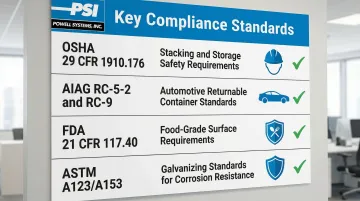
Key regulations governing industrial steel containers include:
- OSHA 29 CFR 1910.176: Mandates containers stored in tiers be "stacked, blocked, interlocked and limited in height so that they are stable and secure against sliding or collapse"
- AIAG RC-5-2: Provides management guidelines for returnable container inventory in automotive supply chains
- AIAG RC-9: Defines performance testing to verify containers withstand typical handling hazards
- FDA 21 CFR 117.40: Requires food-contact surfaces be corrosion-resistant and easy to clean
Specify 304 or 316 stainless steel or food-grade powder coatings. Surface finishes must achieve Ra < 0.8 µm (equivalent to a No. 4 finish) to prevent bacterial growth. Welds must be continuous and smooth—gaps and crevices trap food particles and create contamination risks.
Facility-specific safety protocols may require additional features. Safety latches on drop-gates prevent accidental opening during transport. Rounded edges and deburred metal prevent cuts during manual handling. Specific paint colors support hazard communication programs—red for scrap containers, yellow for work-in-process, green for finished goods.
Documentation requirements include permanently affixed load capacity labels, material certifications for regulated industries, and maintenance records demonstrating compliance with inspection schedules.
Industry-Specific Steel Container Applications
Different industries impose unique requirements that influence container specifications, from food-grade finishes meeting FDA standards to heavy-duty construction withstanding harsh outdoor environments in oil and gas operations.
Automotive and Heavy Truck Manufacturing
Automotive applications demand containers handling heavy stampings, castings, and assemblies. 2,000-4,000 lb capacities handle parts like engine blocks, transmission housings, and body panels through multi-stage production processes.
AIAG standards dictate dimensional requirements—48" x 45" footprints align with AIAG RC-12 specifications for truck transport compatibility.
Containers must meet AIAG RC-9 performance testing verifying resistance to drop impacts, vibration, and stacking loads encountered in supply chain handling.
Drop-bottom designs enable rapid scrap removal at work cells. Stamping operations generate significant scrap metal that must be cleared quickly to maintain production flow.
These containers discharge scrap directly into collection bins without manual emptying, reducing cycle times by 40-50%.
Four-way entry proves essential for containers moving through complex facility layouts with limited maneuvering space.
Formed offset stacking legs maximize floor space utilization in assembly plants where every square foot carries high carrying costs.
Fasteners, Forgings, and Metal Components
Small parts organization requires interior dividers that segment containers for multiple part numbers while preventing cross-contamination.
Contamination-free designs with continuous welded seams eliminate crevices where stray fasteners lodge, supporting quality control programs.
Gravity-feed systems dramatically improve picking efficiency in fastener distribution. Parts flow forward as removed, keeping components accessible at the container's front edge.
This eliminates the 15-20 seconds per pick spent digging through bins, translating to 30-45 minutes saved per worker per shift in high-volume operations.
Steel's durability withstands sharp edges and heavy weights that damage plastic alternatives within months. Forgings and castings with rough surfaces abrade plastic containers, creating contamination from plastic particles.
Steel containers maintain integrity for 10-15 years in these demanding applications, eliminating frequent replacement costs.
Heavy gauge construction (10-12 gauge) handles the concentrated loads from bulk metal parts.
A cubic foot of steel fasteners weighs approximately 490 lbs—a 22 cubic foot container holds 10,780 lbs of fasteners, requiring heavy-duty construction that lighter-gauge containers cannot provide.
Food Processing and IQF Applications
Stainless steel construction (304 or 316 grade) meets FDA requirements for food-contact surfaces. 304 stainless suits general food processing, while 316 stainless with molybdenum provides superior corrosion resistance in acidic environments like tomato processing or facilities using chlorine-based sanitizers.
Smooth surfaces enable sanitation—3-A Sanitary Standards specify surface finishes of Ra < 0.8 µm to prevent bacterial growth. Continuous, smooth welds eliminate gaps that trap food particles and harbor pathogens. Containers must withstand repeated high-pressure washing and chemical sanitization without corrosion.
Drainage features matter for wet environments. Slatted or perforated bases allow water drainage after washing, preventing pooling that creates slip hazards and microbial growth. However, openings must be sized to contain the smallest food products—IQF (Individually Quick Frozen) vegetables require 1/4-inch or smaller perforations.
Steel's temperature resistance suits both freezer applications (down to -40°F) and hot-processing areas (up to 200°F). Plastic containers become brittle in freezers and warp in heat, while steel maintains structural integrity across extreme temperature ranges.
Oil & Gas and Heavy Construction
Maximum-strength containers using 10-gauge steel with reinforced corners withstand harsh outdoor environments, chemical exposure, and rough handling on job sites. Containers may be dragged across gravel, exposed to petroleum products, and subjected to impacts that would destroy lighter construction.
Hot-dip galvanizing per ASTM A123/A153 standards provides long-term corrosion resistance. Galvanized coatings add 1.8-2.2 mils of zinc protection that extends service life to 15-20+ years in coastal or industrial atmospheres where bare steel would rust within months.
Heavy-duty construction accommodates tools, drilling equipment, and pipe fittings with irregular shapes and concentrated weight. Containers must resist puncture from sharp edges and deformation from point loads that would collapse lighter designs.
Higher stacking capability maximizes limited space on offshore platforms and construction sites where ground space carries premium costs. Containers rated for 6,000 lbs can safely stack 3-4 high, tripling effective storage density.
Recycling and Scrap Management
Drop-bottom and dump-style containers enable rapid emptying of scrap materials. Hinged bottoms open to discharge contents in seconds versus minutes required to manually shovel out scrap, improving throughput in high-volume recycling operations.
Wire mesh construction allows drainage of cutting fluids from machining scrap. Solid-wall containers trap fluids, adding weight and creating disposal issues. Mesh containers with 2-inch openings drain fluids while containing metal turnings and chips.
High-capacity designs reduce trips to recycling stations. A 6,000 lb capacity container consolidates scrap from multiple machines, reducing forklift traffic and improving shop floor safety by minimizing material handling frequency.
Custom vs. Standard Steel Containers: Making the Right Choice
While standard containers offer immediate availability and lower costs, custom designs solve specific workflow challenges and deliver ROI through efficiency gains that standard solutions cannot provide.
When Standard Containers Make Sense
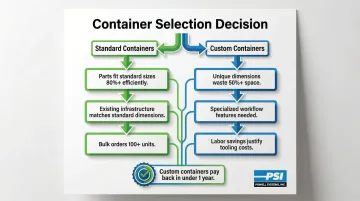
Standard containers work best when operations involve common part sizes that fit efficiently in standard footprints like 32" x 40" or 36" x 48".
If your parts utilize less than 70% of container volume, customization may optimize space, but if utilization exceeds 80%, standard sizes likely provide adequate efficiency.
Your existing infrastructure also plays a key role. If your racking systems, dock doors, and transport equipment already accommodate 40" x 48" pallets, matching these standard dimensions simplifies integration and avoids costly facility modifications.
Finally, bulk purchasing delivers significant savings. Ordering 100+ units of a standard model costs 20-40% less per unit than custom designs, thanks to manufacturing economies of scale that eliminate custom tooling expenses.
When to Invest in Custom Containers
Standard containers aren't always the answer. Custom designs become worthwhile when your specific needs can't be met efficiently with off-the-shelf solutions.
Unique product dimensions that waste space in standard containers justify customization. If parts only fill 50% of standard container volume, custom sizing can eliminate wasted space, reduce shipping costs, and improve storage density. A healthcare manufacturer achieved ROI in less than one year by switching to custom stackable steel bins optimized for their facility's vertical space.
Custom designs also make sense when you need:
- Automated system integration: Precise dimensional tolerances and mounting features for conveyor systems, AGVs, and robotic pick-and-place systems
- Specialized workflow features: Gravity-feed designs or drop-bottom mechanisms that reduce handling time
- Significant labor savings: If a custom feature saves 30 minutes per worker per shift across 20 workers, the annual savings of 10,000 hours ($250,000-400,000) justifies tooling costs of $15,000-30,000 spread across 100+ units
One critical factor: custom tooling costs are typically spread across 100+ units for cost-effectiveness. Below this threshold, modifying standard containers (adding dividers, custom gates, etc.) often provides better economics than full custom design.
Working with Manufacturers on Custom Designs
Start with workflow analysis to identify inefficiencies that container design can address. Document current handling times, damage rates, and space utilization to establish baseline metrics for measuring improvement.
Next, prototype development validates your design assumptions before committing to production tooling. Testing under actual conditions reveals handling issues, dimensional conflicts, and usability problems that aren't apparent in CAD drawings.
Expect iterative refinement based on operator feedback and real-world performance data. The first prototype rarely achieves optimal design—plan for 2-3 iterations to refine dimensions, access features, and handling characteristics.
Throughout this process, partner with experienced manufacturers who understand material handling principles. Companies like Powell Systems, with over 100 years of experience in steel container design, have solved similar challenges and can recommend proven features rather than untested concepts that create new problems.
How Powell Systems Can Help
Powell Systems brings over 100 years of steel container manufacturing expertise to your operational challenges. Whether you need immediate delivery of standard containers or custom-engineered designs, their team helps you select solutions that improve workflow efficiency.
Proven Expertise and Innovation
Founded in 1920 by William J. Powell as Powell Pressed Steel in Hubbard, Ohio, Powell Systems has manufactured material handling equipment for four generations. The company pioneered specialized designs including gravity-feed containers that increased parts handling efficiency by 40% in assembly operations and drop-bottom containers that became industry standards for rapid parts discharge in assembly operations.
Their flagship Flowmatic® gravity-feed container features formed offset stacking legs that allow stackability with four-way entry. The design eliminates protruding corners and channels, providing forklift accessibility from all sides while maintaining seamless material flow.
Powell Systems developed the B3 "Smooth Sided" container with contamination-free design engineered to minimize cross-contamination of fasteners and small stampings between containers—a key improvement for quality control in fastener manufacturing.
Comprehensive Product Line
Powell Systems offers both standard corrugated steel containers for immediate needs and custom-designed solutions tailored to specific operational challenges. Their product line spans from small-capacity units to large-scale industrial bins, all manufactured at their Fowler, Indiana facility.
Standard container models include 4-way entry designs with 4,000 lb capacities, gravity-feed Flowmatic® containers supporting 4,000-5,000 lbs, and heavy-duty "The Brute" containers for extreme applications. Material gauge options range from 7 to 14 gauge steel, allowing precise matching of container strength to load requirements.
Customization capabilities include:
- Variable dimensions and height adjustments in 3-inch increments
- Underclearance options from 4 to 12 inches
- Choice of 2-way or 4-way entry configurations
- Custom corrugation orientations and interior dividers
- Specialized gates and oil-tight designs
- Hinged bottom dump configurations for scrap handling
Customer-Focused Solutions
Powell Systems' consultative approach begins by listening to your unique product and packaging specifications to recommend optimal container solutions.
Their engineering team analyzes workflow challenges and delivers specifications that generate measurable labor and product savings.
The company serves diverse industries including automotive, fasteners, heavy construction, oil and gas, and food processing, with deep expertise in the unique requirements of each sector. Their track record includes custom solutions like containers with roll-over channels featuring four-way accessibility and heavy-parts containers with dual drop gates.
Contact Powell Systems at (765) 884-0613 or info@powell-systems.com to discuss your steel container requirements and explore how their century of manufacturing expertise can optimize your material handling operations.
Conclusion
Selecting the right steel container isn't about finding the most popular option or the lowest price—it's about matching container specifications to your specific operational requirements, product characteristics, and long-term cost objectives. A container that saves $200 upfront but costs $5,000 annually in damaged products and inefficient handling represents false economy.
The key factors must align with actual workflow conditions to deliver value:
- Material gauge matched to product weight and handling frequency
- Design configuration suited to your specific operation (gravity-feed for assembly, standard for bulk storage)
- Load capacity appropriate for your application without over-engineering
- Handling features that improve efficiency in your facility
- Industry compliance meeting safety and regulatory requirements
A gravity-feed container transforms picking efficiency in assembly operations but adds unnecessary cost in bulk storage applications. A 10-gauge container provides decades of service in heavy foundry work but represents over-engineering for lightweight packaged goods.
View container selection as part of continuous operational improvement.
As processes evolve and production volumes change, periodically reassessing container specifications ensures your material handling system remains optimized for efficiency and safety rather than locked into solutions that no longer fit your needs.
Frequently Asked Questions
What is the typical lifespan of industrial steel containers?
Properly maintained steel containers typically last 10-15 years in industrial environments, depending on gauge thickness, usage intensity, and conditions. This far exceeds plastic (3-5 years) and wood (1-2 years) alternatives, making steel more cost-effective despite higher upfront costs.
How much weight can steel containers safely hold?
Capacity varies by construction: light-duty containers (14-16 gauge) handle 500-1,500 lbs, medium-duty (12-14 gauge) support 1,500-2,500 lbs, and heavy-duty (10-12 gauge) safely carry 2,500-4,000+ lbs. Specialized designs support up to 6,000 lbs.
What's the difference between corrugated and solid-wall steel containers?
Corrugated containers feature ribbed walls for high strength-to-weight ratios and partial visibility, weighing 15-20% less than solid-wall designs. Solid-wall containers offer complete containment for small parts and liquids, plus easier cleaning for food-grade applications.
Can steel containers be customized for specific applications?
Yes, manufacturers like Powell Systems offer extensive customization including dimensions, specialized features (gravity-feed, drop-bottom, dividers), surface finishes, and accessories. Custom orders typically require minimum quantities of 100+ units, though this varies by manufacturer and complexity.
Are steel containers suitable for food-grade or pharmaceutical applications?
Yes, when specified with appropriate materials: 304 or 316 stainless steel or food-grade powder coatings meet FDA requirements. Smooth surfaces with Ra < 0.8 µm finishes enable proper sanitation, and steel's non-porous nature prevents bacterial harboring. Documentation proving material compliance is typically required for regulated industries per FDA 21 CFR 117.40 standards.
How do I determine the right container size for my operation?
Measure part dimensions and weight, consider handling equipment capacity (forklifts, racking), calculate workflow batch sizes, and match to available container dimensions. Build in a 20-30% safety margin beyond calculated loads. Consulting with manufacturers provides recommendations based on similar applications.